 EverNest
An AI coworker
for the everyday
work of care.
Starting with childcare, EverNest is being developed to help early childhood educators and childcare providers capture daily moments, organize care details, and prepare updates for families using their voice.
Speak naturally about the moments that matter. EverNest organizes your spoken details into drafts for you to review, revise, and save or approve for sharing. Manual entry is also available whenever you prefer it.
AI drafts. You review and decide what to share.
Designed for the phones and tablets you already use—including iPad.
On your phone or tablet
Open EverNest, tap the microphone, and speak naturally. Your spoken care details become an organized daily report draft for you to review, revise, and save or approve for sharing with families. Manual entry remains an option when typing is more convenient.
Wearable concept · Not available yet
A future wearable option
We’re also exploring an optional wearable button to start voice capture without reaching for your phone. Review and revise the resulting draft on your phone or tablet before saving or approving it for sharing.
THE PROBLEM
Childcare doesn’t happen behind a desk.
Traditional, form-based childcare reporting can require educators to pause, find the right screen, scroll through options, and type information. During hands-on care, those steps can compete for the attention children need.
Inspired by firsthand childcare experience and conversations with other educators, EverNest is being designed around the everyday challenge of documenting care while meeting children’s needs. Those daily responsibilities include:
- Holding babies
- Serving meals
- Supervising play
- Comforting children
- Guiding daily transitions
- Handling incidents
And so much more.
EverNest was created because documentation and attentive care should not have to compete for the same moment.
Speak. EverNest drafts. You approve.
One tap on the microphone starts a capture, wherever the day takes you.
Describe meals, naps, potty updates, daily observations, achievements, and learning activities in your own words.
Capture notes about curriculum activities and reminders for families. Add photos to complement your updates when that feature is available.
EverNest prepares a draft from only the details you captured.
Check the child, time, facts, and recipients; revise if needed.
Saving a draft and approving it for sharing are separate — nothing is shared until you approve.
Designed for the phones and tablets you already use.
One place to capture care—and return to what needs attention.
This is the EverNest teacher home screen: a central starting point for capturing care details, reviewing drafts, finding reminders, and returning to the things that need your attention.
On the home screen
- Tap to talk — starts voice capture for care details.
- Create manually — enter care details using familiar forms when you prefer to type.
- Reminders — counts active reminders and opens the list.
- Review — drafts EverNest prepared that still need your confirmation.
- Parent — family-facing items not yet sent, opened, or acknowledged.
- Today’s log — everything recorded today, finished or not.
- My Classroom — who’s present and enrolled; opens your classroom.
- Needs your attention — outstanding items, each opening the exact record.
In the prototype
Daily care reports
Tap the microphone and speak naturally about meals, naps, potty updates, daily observations, achievements, and learning activities. Your spoken details become an organized daily report draft for you to review, revise, and save or approve for sharing with families.
Planned
A place for thoughts to land
Quick thoughts, tasks, parent talking points, and reminders go to My Attention Board, to return to when time allows. They stay private unless you approve sharing.
“Remind me to tell Noah’s dad to bring extra clothes.”
In-app reminders in the prototype · Timed voice requests and device alerts planned
Reminders and timed follow-ups
Ask for a reminder to finish unfinished documentation. A reminder appears inside EverNest; it is not an alarm, and it never replaces timely incident care, reporting, or family communication.
“Remind me at 1 p.m. to finish Kellen’s incident report.”
Planned · Not available yet
Notes for the Next Teacher or Team Member
Keep important handoff details, family requests, and unfinished tasks organized so the next teacher, substitute, or authorized team member knows what needs attention. Private notes remain separate, and information is shared only with the appropriate people.
- “Remind the closing teacher to move the laundry to the dryer when the wash finishes.”
- “Noah’s mom asked us to send his backpack and swimsuit home on Friday.”
- “Let the substitute know that Mia prefers her blue blanket at nap time.”
Observations in development · Progress tracking and assessment support planned
Capture Little Moments. See the Bigger Picture.
Children grow and learn through everyday moments, and teachers notice meaningful progress throughout the day. With EverNest, educators can simply speak their observations as they happen. EverNest is being designed to help organize those observations into each child’s individual developmental record, making it easier to revisit milestones, recognize patterns of growth, and prepare for assessments and parent-teacher conferences.
- 1. Notice and Speak: A teacher notices a child’s achievement, behavior, emerging skill, or developmental milestone and records it through voice.
- 2. Organize by Child: EverNest helps identify the appropriate child and suggests relevant developmental areas, such as language, cognitive, social-emotional, physical, or self-help development.
- 3. Review and Save: The teacher verifies the child’s identity, observation, and details before saving.
- 4. Revisit Progress: Saved observations can be reviewed over time to support progress tracking, documentation, assessments, and parent-teacher meetings.
“Emma counted five blocks independently today and correctly identified blue and red.”
This observation could be saved under Emma’s individual profile and organized into relevant developmental areas for later reference.
AI helps organize what you share; it does not evaluate or diagnose a child’s development. Educators keep their professional judgment and review every observation.
Examples use fictional names.
This is the intended experience being developed. AI should organize only the details captured, never invent missing information. Educators review and authorize the next step.
AI prepares. Human decides.
Three ways to record children’s daily care
Choose the method that fits your moment. Voice comes first, and typing is always there when you need it.
Voice recording
Speak a child’s care details, and AI prepares a draft for you to review.
Quick Report
Log everyday care with familiar quick-tap choices when tapping is easier than speaking.
Full Report / Manual Entry
Prefer the familiar way? Use forms to enter care details and type your notes.
More than daily reports.
Everyday care records—and a place for your thoughts to land.
EverNest is being developed to support familiar daily care records through a voice-first workflow. The intended experience starts with tapping the microphone and speaking naturally, reducing the need to find a specific report and type each detail into a form.
Beyond daily reports, capture the little things you don’t want to forget: something to tell a parent, a supply you need, an observation, an idea, or a task to revisit. Give those thoughts somewhere to land before the next busy moment takes your attention.
- Daily care — meals, naps, potty updates, and everyday care records.
- Observations — developmental notes and meaningful moments that can support family conversations and conference preparation.
- Reminders and tasks — supplies, follow-ups, and things needing attention.
- Quick thoughts — ideas and details to revisit when time allows.
- Family updates — pickup talking points and message drafts for educator review and approval.
Planned capabilities · Not available yet
Concept preview · Planned feature
My Attention Board
A place for your thoughts to land. Return to captured reminders, parent talking points, observations, and ideas when your day allows.
Captured items are intended to stay private by default · Fictional sample cards
To review
Review Ava’s observation: She put on her coat independently.
To do
Restock wipes.
To tell families
Tell Noah’s dad: Please bring extra clothes.
Internal list — not sent automatically. You review and approve before anything is shared.
Ideas for later
Revisit an idea: A leaf activity for next week.
A few ways EverNest is designed to help.
These illustrative workflows show how spoken details could become organized drafts, observations, and follow-ups. They are examples within the broader EverNest childcare-management platform.
Illustrative workflows · Fictional children and information · Not a live product demo.
A classroom lunch update
“Lunch was served to everyone here in Butterflies: spaghetti, garlic bread, strawberries, and milk.”
- Meal
- Lunch
- Food served
- Spaghetti, garlic bread, strawberries, milk
- Group
- Butterflies
- Attendance context
- 11 present out of 12 enrolled, using a fictional active roster
Awaiting educator review
The intended workflow uses classroom attendance at the time of the care event—not all enrolled children. The educator confirms the included children.
Served does not mean eaten. Appetite, quantities, dietary restrictions, allergies, and individual exceptions are not inferred.
Intended choices: Review and revise → Update record, Send approved update, or Save for later.
View the broader platform concept
Tap the image to zoom in.
Illustration of selected intended workflows using fictional information. Some capabilities are planned; not a live product demo.
Important work stays visible.
EverNest is being designed to bring unfinished drafts, missing details, reminders, and follow-ups together so educators can return to them when care allows.
Needs attention
Interrupted captures, missing details, drafts awaiting review, and reminders
Completed activity
Approved records and saved observations
We’re developing ways to preserve captured information and help educators resume interrupted work. Capture recovery and reliability remain development and testing priorities.
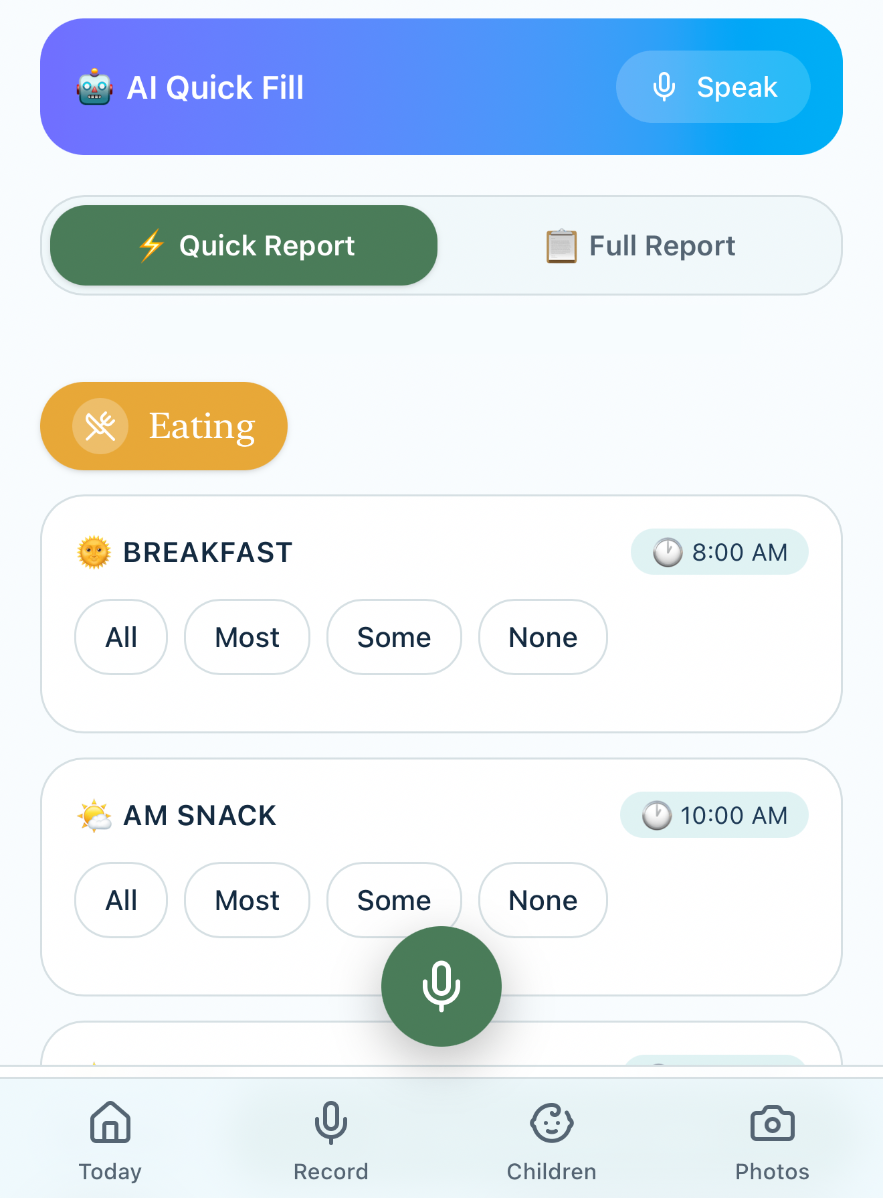
A Look at the EverNest MVP
An early look at EverNest’s Quick Report interface, built as part of the MVP to demonstrate its reporting workflow.
Designed for the whole care team.
EverNest’s vision extends beyond individual care notes to support daily care, child records, attendance, family communication, reminders, and administrative tasks. The same coworker approach is being developed with educators, directors, owners, and families in mind.
Designed for licensed home childcare providers, childcare centers, preschool educators and directors, and professional nannies.
- Educators
- Easier capture of care details and clearer follow-through.
- Families
- Meaningful updates reviewed and approved by educators.
- Directors and owners
- An organized view of documented care and pending tasks, with access based on each person’s role.
These are development goals that will be evaluated through future testing. Planned administrative tools are identified below.

What’s next for EverNest
Our software roadmap focuses on making everyday care administration simpler.
Our first childcare version is in development. Pilot testing has not yet started.
Current prototype
The prototype illustrates the workflows below. Functionality and reliability are still being developed and tested.
- Voice capture
- Quick Report
- Manual entry
- Report drafts
- Reminders and follow-ups
- Attendance
- In-app family messaging
- Caregiver review and approval
Planned software
These features are planned for future releases.
- Billing and automatic payments — intended Phase 1 scope; not yet available.
- Expanded tools for administrative tasks
- Enhanced reporting and report validation
Planned · Not available yet
More Thoughtful Tools Planned
EverNest is being designed to grow alongside the everyday needs of educators and care programs. Additional features are planned to support developmental documentation, assessment preparation, program organization, and other important responsibilities, with each tool thoughtfully developed to make daily work simpler and more manageable.
Future accessory concepts
Wearable voice-capture accessories are concepts we’re exploring for the future. Details appear in the accessory section below.
Founder Jovelyn Galvin’s vision guides the ideas behind EverNest—from software features to future accessory concepts. Drawing on firsthand childcare experience and conversations with caregivers, she identifies everyday challenges and explores practical ways to address them. Each new idea is considered for the value it could bring to caregivers, programs, and business owners: making work easier, supporting daily operations, and allowing more attention for care. User feedback and testing will help determine which ideas move forward, starting with childcare and adapting to other care fields over time.
Starting with childcare. Built with a broader vision for care.
EverNest begins in childcare, grounded in firsthand experience with the daily responsibilities of educators and providers.
Our long-term vision is to bring the same voice-first coworker concept to other care and education settings. Each field has its own responsibilities, routines, and documentation needs. Future versions would adapt the layout, language, and workflows to fit the people using them.
The purpose stays the same: helping people stay present with those they care for while AI assists with the work around that care.
Designed to move with you
Phones and tablets are the starting point. Our accessory vision builds on that foundation with more ways to capture notes throughout the day.
The concept centers on one removable voice-capture button designed to move between a shirt clip, necklace holder, bracelet holder, and flexible desktop stand. A separate companion headset is envisioned for private audio feedback.
One button. Different ways to carry it. Designed around the way caregivers move through their day.
AI-generated illustrations of concepts we’re exploring for the future. These concepts require engineering and testing; availability and timing will be shared as development progresses.
Wearable concept · Not available yet
On the floor with the children? We’re exploring a wearable button that could let you start voice capture without reaching for your phone, then return to EverNest to review the draft when time allows.
How the button would connect and record is still being worked out.
Meet the Founder — Building a Coworker for the People Who Care.

Jovelyn Galvin is an early childhood educator, childcare business owner, and founder of EverNest. With more than 14 years of hands-on experience in early childhood education, including working in a childcare center and operating her own family childcare business, she brings a firsthand understanding of educators’ daily responsibilities and challenges. Her professional relationships and conversations with fellow teachers, childcare providers, and center owners have broadened her perspective on the needs of different childcare settings, helping shape the ideas and vision behind EverNest.
She leads EverNest’s product vision, care workflow design, and creative direction, with every decision guided by a simple goal: to make everyday work easier through intuitive design, practical features, and meaningful support.
Why I’m Building EverNest
For a long time, I prayed to find meaningful work where I could dedicate my time, effort, talents, and perseverance to something with a greater purpose—something that could make a meaningful difference in people’s lives and allow the impact of my work to extend beyond what I could accomplish on my own.
Looking back on my years in early childhood education, I began to realize that the experiences, challenges, and lessons I had gained along the way were shaping a purpose I had not yet fully recognized. I believe those experiences helped lead me toward building EverNest.
Throughout my years as an early childhood educator and childcare provider, I’ve experienced firsthand how demanding and unpredictable each day can be. There are moments when so much is happening at once that even the smallest interruption can divide our attention between caring for children and keeping up with the responsibilities that come with the job.
I remember one particular incident that made me reflect more deeply on this challenge. While I was entering care information for one child, another child was bitten. It reminded me how quickly situations can unfold and how difficult it can be to balance documentation with the constant awareness and attention that caring for children requires.
It wasn’t just that one incident. Over the years, I’ve experienced many moments when important observations, small details, and things worth documenting could easily slip from memory while attending to other responsibilities. Those experiences made me increasingly aware of the need for tools that could better support the way teachers and caregivers actually work.
Beyond the physical demands of caring for others, there is also the mental load of remembering what needs to be done, what needs to be documented, what needs to be communicated to families, and what still requires attention. Even with the support of existing childcare management software, entering information can sometimes feel like another responsibility competing for the attention we want to give the children in our care.
These experiences made me question why the tools designed to support teachers and caregivers still required so much of the attention we needed for the people around us.
Teachers and caregivers spend their days moving between responsibilities, responding to needs in the moment, and making countless decisions while caring for others. I believe their software should fit naturally into that reality, helping them capture important information as it happens, reduce the burden of remembering everything, and manage everyday responsibilities without becoming another task to manage.
These experiences inspired my vision for EverNest—a voice-first AI coworker designed to support the everyday work of care. Rather than relying entirely on traditional screen-based interactions, I envision software that educators and caregivers can speak to naturally, helping them capture important moments, organize information, prepare documentation, remember tasks, and manage daily responsibilities while staying focused on the people they care for.
I began interviewing people working in childcare and other care fields to better understand their challenges, experiences, and everyday needs. Those conversations continue to broaden my perspective and shape the features, workflows, and direction of EverNest.
Bringing EverNest to Life
As a nontechnical founder, I’m exploring the startup world, learning new skills, and steadily connecting the dots between the needs I understand and the technology that can address them. I’ve built an MVP using Lovable and am continuing to refine it, guided by my firsthand experience and the insights I gain from other care professionals.
I’m committed to building EverNest while continuing to draw on my experience as an early childhood educator and childcare provider. I’m actively seeking the right engineering partner, collaborators, and investment to help strengthen the product and bring this vision to life. With the right funding and support in place, I’m prepared to transition into building EverNest full-time, giving it the focused attention and dedication needed to grow into a reliable tool for everyday care.
As I continue this journey, I’m eager to deepen my understanding of technology and the startup world, learn from experienced founders and industry professionals, and connect with like-minded people who bring different perspectives and complementary skills. I’m interested in participating in events, programs, and opportunities that encourage learning, meaningful collaboration, and personal and professional growth.
A Vision Beyond Childcare
My immediate focus is developing EverNest as voice-first childcare management software, designed around the practical needs of teachers, caregivers, and childcare programs.
While childcare is where EverNest begins, my broader vision is to bring the same AI coworker approach to other care professions. Each field has its own responsibilities, workflows, and challenges, and I believe the technology should thoughtfully adapt to those differences rather than expect everyone to work the same way.
My goal is to build something that grows with the needs of the people using it, where every feature serves a clear purpose, brings practical value, and helps care professionals spend less time managing software and more time focusing on the people they serve.
“My goal isn’t to replace the people who provide care. It’s to give them technology that makes their work easier and allows them to focus on what matters most.”
Help bring EverNest into real-world pilot testing.
We’re connecting with childcare providers and educators interested in participating in future pilot testing.
Our development priorities include:
- Strengthening software engineering and reliability
- Preparing privacy and security safeguards and reviewing applicable requirements
- Completing essential workflows for pilot testing
Technical collaborators, partners, and investors are also welcome to connect. Our immediate focus is the core software, with future accessory concepts following a separate research and development path.